Munch Scream Pokémon Cards: History, Value, and Where the Market Stands
Five cards, one museum exhibit, and the most distinctive promo set Pokémon has ever printed. The full story of the 2018 Munch Scream cards — and where the market sits now, eight years on.

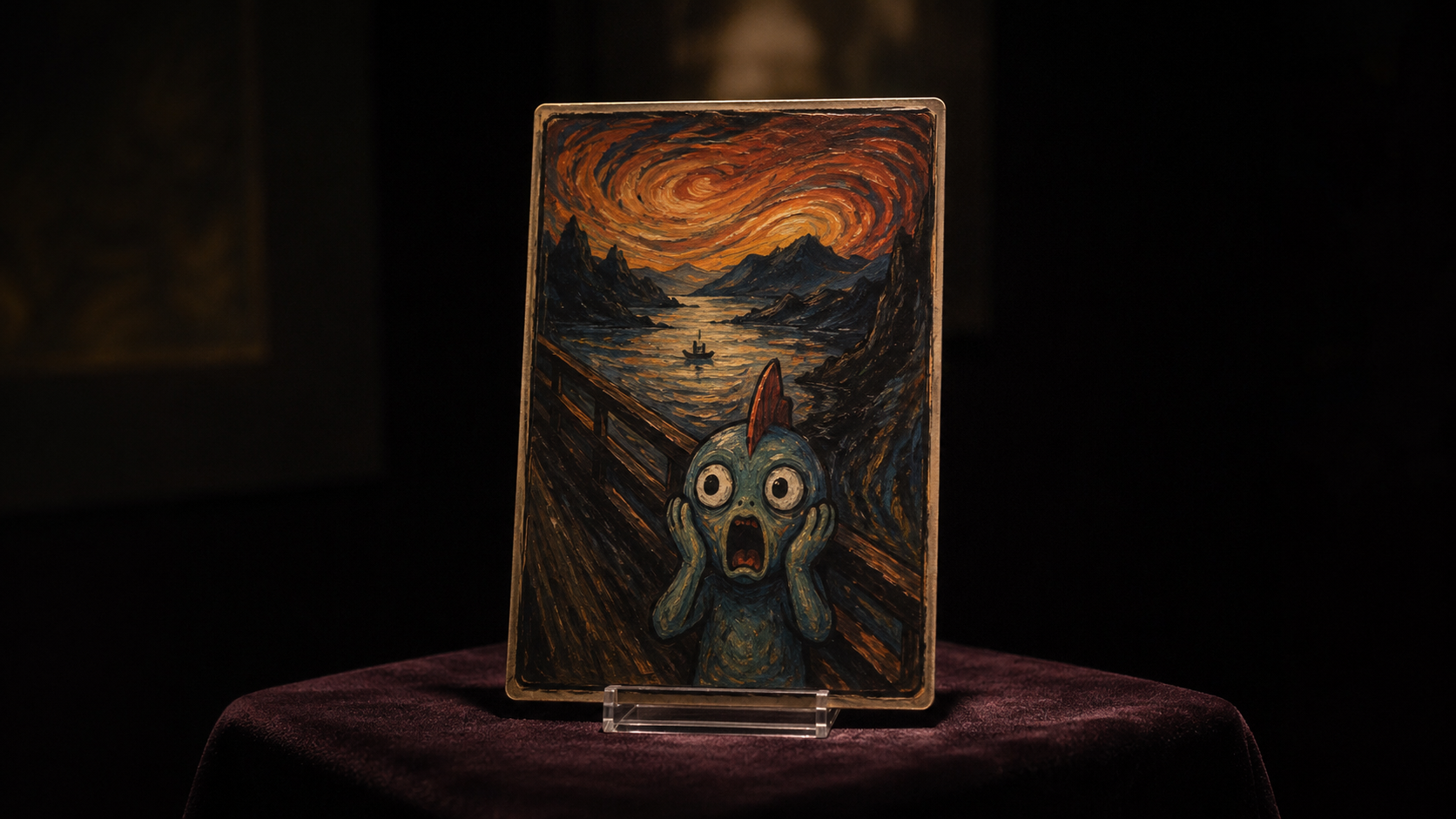
There are plenty of Pokémon promo cards. There's only one set that hangs in fine-art conversation. The five Munch "Scream" promos — released in late 2018 to mark Edvard Munch's first major Japanese exhibition — are arguably the most distinctive promo cards The Pokémon Company has ever printed, and almost eight years later they're still drifting upward in value and still being faked at scale because the demand never softened. This is the full story: how they happened, how the market priced them over the years, and where things actually stand in 2026.
The exhibit that started it
In October 2018, the Tokyo Metropolitan Art Museum opened a major retrospective called "Munch: A Retrospective." It ran from October 27, 2018 through January 20, 2019, and it was a genuine cultural moment in Japan — it marked the very first time Edvard Munch's The Scream had been displayed in the country. Specifically, the version on display was the 1910 tempera-on-cardboard rendition of the painting (Munch made multiple versions across his life; the more famous 1893 oil sits in the National Museum of Norway).
The Pokémon Company partnered with the museum on a small line of tie-in promotional materials. There were brochures, postcards, a museum-tagged Pikachu plush — and five trading cards, each one depicting a Pokémon in the Scream's iconic horrified pose. From a marketing standpoint it was a clever fit. Munch's work is built around existential dread, and Pokémon — despite the franchise's cheerful surface — has always been quietly full of it. Cubone wears its own mother's skull on its head. Phantump is the spirit of a child who died in a forest. Mimikyu is so isolated it disguises itself as a Pikachu to be loved. A line of cards translating Munch's anxiety into Pokémon was a more natural pairing than most casual observers gave it credit for at the time.
What nobody at the time predicted was how big these cards would become.
The five cards
The five Munch Scream promos are catalogued in the Japanese SM-P (Sun & Moon Promo) numbering system. In order:
- 286/SM-P — Psyduck, holding its head in a perfect homage to its trademark headache pose, set against Munch's stormy sky
- 287/SM-P — Eevee, transformed from cute mascot into wide-eyed shock against a fiery orange sunset
- 288/SM-P — Pikachu, the centerpiece of the set, standing on the bridge in full Scream pose with a horrified expression
- 289/SM-P — Mimikyu, whose shadowy disguised form blends almost seamlessly into the swirling darkened background
- 290/SM-P — Rowlet, fluttering in distress in a rare dynamic pose for the Grass-type starter
Every card was illustrated by Atsuko Nishida — the artist responsible for many of Pokémon's most iconic original designs, including the original Pikachu — and every card uses an art style nothing like a normal Pokémon TCG illustration. Instead of Ken Sugimori's clean lines or the 3D digital style typical of modern promos, these cards use heavy oil-style brushwork, warped perspective, and Munch's anxiety-driven warm palette. The result is unmistakable. Even glanced at across a room, a Munch Scream card doesn't look like a Pokémon card. That's the entire reason they became collector grails.
The detail that drives the whole market: distribution
Here's the part most casual coverage glosses over, and it's the single most important fact for understanding the price spread between these cards.
The five Munch cards were not distributed equally. Three of them — Psyduck, Eevee, and Rowlet — were handed out at Pokémon Centers across Japan as promotional cards for customers buying two booster packs. Easy enough to get if you were in Japan during the window. Mimikyu was available from the Pokémon Center online store, slightly more limited but still broadly accessible.
Pikachu was different. Pikachu was only available at the museum exhibition itself, one per person, only during the run of the show. To get one, you had to physically attend the "Munch: A Retrospective" exhibit in Tokyo between October 2018 and January 2019. That asymmetry is the whole reason Pikachu (288) commands several times the value of its sibling cards today. Same set, same artist, same era — but a fundamentally smaller supply created by a fundamentally different distribution channel. This is the rare case in modern Pokémon where the scarcity story is genuinely structural rather than manufactured marketing.
The market over the years
For the first couple of years after release, the Munch cards were tracked mostly by Japanese-promo specialists and didn't command extraordinary prices. They were known to be cool and limited, but the broader Pokémon market hadn't yet entered the era where promo cards routinely cleared four figures.
Then 2020–2021 happened. The pandemic-era Pokémon boom lifted essentially every sealed and limited card in the market, but it lifted the Munch set harder than most. Two factors stacked. The first was the obvious one — every Pokémon collectible was getting reappraised upward. The second was that the Munch cards had genuine crossover appeal to people outside the traditional TCG world, because they read as fine-art objects in a way nothing else in the TCG did. When a card looks like a thing you'd hang on a wall, the buyer pool grows.
By mid-2021, PSA 10 Pikachus had cleared the $3,000–$5,000 range. By the boom's peak, individual auction sales pushed higher. Then came the broader 2022 correction in collectibles, and prices on the Munch set softened along with everything else. PSA gave an average PSA 10 Pikachu value around $2,132 during that softer 2023 stretch — a real pullback, but holding well above pre-boom levels.
The recovery from 2024 onward has been quieter than the original boom but steady. Recent auction data tells the story plainly. In the second half of 2025, PSA 10 Pikachu 288 sales clustered roughly between $4,400 and $7,800 — most landing in the $5,000 to $7,000 range — with at least one transaction noted at $5,000 in early October 2025 and PSA 9 copies trading anywhere from $1,675 to $6,990 depending on the specific listing and timing. The bottom of the Pikachu market is firmly in four figures and the top is genuinely flirting with the $10,000 mark that the Vice "most expensive Pikachu cards" coverage cited for 2026.
The other four cards in the set sit considerably lower. Eevee, Psyduck, Rowlet, and Mimikyu raw or lightly-graded copies trade in the high hundreds to low thousands depending on grade and condition. Sealed Eevee 287s have crossed at $740 to $950 in 2025 listings; complete five-card PSA 10 sets paired with the museum brochures and postcards have been listed at $26,000-plus. The spread between Pikachu and its siblings — roughly 5x to 10x in equivalent grades — is the persistent footprint of that museum-exclusive distribution decision in 2018.
Where it stands in 2026
The current state of the Munch Scream market is, in a word, stable — and that's significant. Many cards that ran hard in 2020–2021 spent the following years bleeding back toward their pre-boom levels. The Munch set didn't. After the 2022 correction, it found a floor and has held above it. That kind of durability across multiple market cycles is what separates a temporary hype card from a genuine grail.
A few specifics worth knowing for anyone trying to understand the market today:
PSA 10 population on the Pikachu 288 sits around 3,597 of roughly 6,845 total graded copies. That's a meaningful population — these aren't unicorns — but it's also not enough supply to crash prices given how many people want one. The card has settled into the comfortable territory of "rare enough to hold value, common enough to actually transact."
The sibling cards (Psyduck, Eevee, Rowlet, Mimikyu) collectively form what most collectors consider the "approachable" end of the set. They're the cards people who can't drop $5,000 on a Pikachu pick up first, and they tend to move steadily. Mimikyu — the online-only Pokémon Center distribution — sits slightly above the other three in most grades.
Buying a complete set is the path serious collectors gravitate to. Sealed and high-grade complete sets command a premium beyond the sum of their parts because the set, intact, is a clear museum-style display piece in a way the individual cards aren't. The $26,000 complete-set listings reflect that premium.
And the chase factor at the top end — the museum brochures, the museum-tagged Pikachu plush, the Psyduck postcard — has become its own collector niche. Some collectors aren't satisfied with the five cards anymore; they're chasing the full "museum visitor's haul" as a kind of period artifact from the exhibition itself.
The counterfeit problem
If you're going to buy into the Munch set, this is the part that matters more than any market analysis: these are among the most heavily counterfeited Pokémon promos in existence.
The combination of high per-card value, distinctive but reproducible art style, and Japanese-only distribution (which lets bad actors hide behind language and shipping friction) has made the Munch cards a prime target for sophisticated fakes. Some are obvious. Many are not. The market is full of "raw" Munch cards listed at suspiciously fair prices, and a meaningful percentage of them are reproductions. For high-value purchases, PSA or BGS grading isn't optional — it's the only realistic protection. Even then, vigilance matters: the population reports tell you what to expect, and any deal that looks dramatically below recent comparables almost always is.
(For more on what to actually look for, see the deeper counterfeit-detection breakdown elsewhere on the site — it's worth reading before any meaningful purchase.)
The bottom line
The Munch Scream set occupies an unusual place in the Pokémon landscape. It's modern enough that copies exist in real numbers, distinctive enough that demand reliably outstrips supply, structurally scarce in the way that actually matters (one card was a museum-exclusive, period), and crossover-appealing enough that the buyer base extends well beyond the typical TCG collector. Eight years on, the market still treats it as a centerpiece collection rather than a curiosity — and the price stability through two full market cycles suggests that's how it's going to be treated for a long time.
If you're new to the set, the entry points are the sibling cards. If you're chasing the centerpiece, the Pikachu 288 in a PSA 9 or 10 is the trophy, and it's not getting cheaper. And whatever you do, never buy a raw one without scrutinizing it like your wallet depends on it — because it does.