Pokémon Is Cleaner on the Shelf Than It Is Behind the Counter

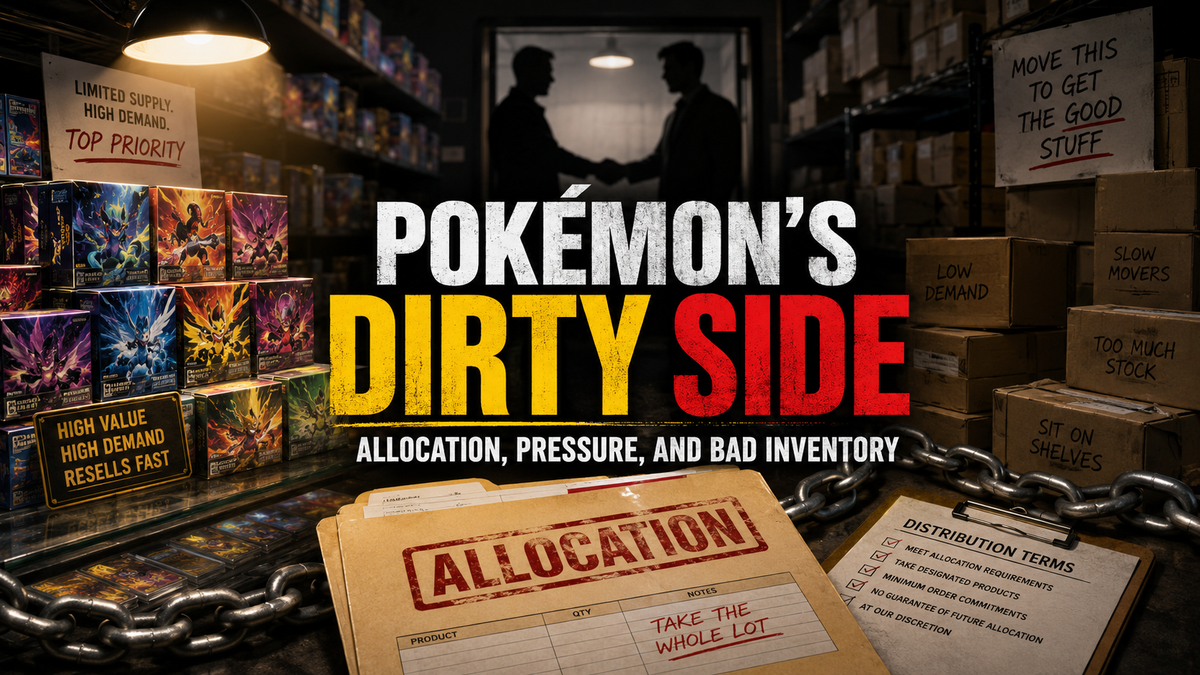
Pokémon looks wholesome from the outside. Bright packaging, nostalgic artwork, kids trading cards at lunch tables, adults chasing Charizards like it’s 1999 again. To the average customer, the Pokémon TCG aisle seems simple: a store orders product, a distributor sends it, and collectors buy it.
Behind the scenes, it is often much messier.
The Pokémon card market has a problem that rarely gets discussed outside retailer circles: the distribution and allocation system can create incentives that feel unfair, opaque, and, at times, borderline coercive. Not necessarily illegal. Not necessarily a grand conspiracy. But definitely dirtier than the glossy booster box sitting on the shelf would suggest.
At the center of the issue is one word every card shop knows too well:
Allocation.
When demand is high, retailers often cannot simply order as much Pokémon product as they want. Instead, distributors decide how much each store gets. A retailer might request 100 cases and receive 10. Or request 20 and receive 2. Sometimes they receive nothing. The official explanation is usually predictable: limited supply, high demand, fair distribution, historical purchasing patterns, account size, and so on.
Some of that is real. Pokémon is enormous, demand spikes are brutal, and no distributor can magically create infinite product.
But the problem is not merely that allocation exists. The problem is how allocation can be used.
For smaller retailers, allocation can feel less like a neutral supply-management system and more like a leverage tool. A shop may be told, directly or indirectly, that better access to hot Pokémon releases depends on their overall purchasing relationship with the distributor. In plain English: buy more of the stuff nobody wants, and maybe you will get more of the stuff everybody wants.
That is where things start to feel ugly.
A retailer does not just want booster boxes. They need booster boxes. Pokémon brings customers through the door. It drives repeat traffic. It creates social media buzz. It gives local game stores a reason to exist in a world where consumers can buy almost anything online. When a distributor controls access to that product, they control a major part of a store’s oxygen supply.
And when oxygen is rationed, people start accepting bad deals.
The most frustrating version of this is the alleged “take the garbage with the gold” arrangement. A distributor may have slower-moving product sitting in the warehouse: unpopular games, overprinted accessories, dead inventory, weak releases from other brands, or random items that are difficult for small stores to sell profitably. The retailer does not really want this product. Their customers do not really want it either. But the retailer may feel pressure to buy it because refusing could mean getting worse access to the next Pokémon release.
Nobody has to phrase it like a movie villain.
It does not need to be, “Buy these unsellable cases or you will never get Pokémon again.”
It can be softer than that. More corporate. More deniable.
“Accounts that support the full catalog tend to receive stronger allocations.”
“We prioritize partners who maintain consistent purchasing volume.”
“Your Pokémon numbers are based on your overall relationship with us.”
“Taking some additional product may help your account.”
The retailer hears the real message: you want the hot product, so help us move the cold product.
This creates a strange economy where the best-selling brand in the category can be used as a bargaining chip to move inventory that would not stand on its own merits. In a normal market, a bad product fails because retailers do not reorder it. In this market, weak product can sometimes piggyback on the strength of Pokémon. The retailer absorbs the risk, the distributor cleans up its inventory problem, and the customer eventually sees weird clearance bins full of stuff nobody asked for.
The system also rewards size over community.
Large accounts often have more leverage, more volume history, more cash flow, and more ability to absorb bad inventory. A big retailer can buy deep, sit on product, discount mistakes, and still survive. A small local game store cannot always do that. For them, being forced into mediocre inventory can be the difference between a profitable month and a painful one.
That means the stores most dependent on Pokémon are often the least powerful in the chain.
And that is the part that feels backwards. Local game stores are the places that build Pokémon culture. They host trade nights. They teach kids how to play. They deal with parents, collectors, scalpers, returns, theft, damaged boxes, and release-day chaos. They are the human layer between the brand and the community. Yet many of them operate with very little visibility into why they get the allocation they get.
One month, they receive a decent amount.
The next month, they get cut.
Was it because supply was lower? Because another account was prioritized? Because they did not buy enough non-Pokémon product? Because they complained? Because they are too small? Because someone else had a better relationship with the sales rep?
Often, they do not really know.
That lack of transparency breeds resentment. And honestly, it should.
Allocation may be unavoidable in a hot market, but opacity is a choice. If product is limited, retailers can accept that. What is harder to accept is being kept in the dark while being nudged to make purchasing decisions that may not be in their best interest.
The entire arrangement creates a quiet conflict of interest. Distributors are supposed to supply retailers. But when distributors also decide who gets access to scarce, high-demand product, they gain power far beyond simple wholesaling. They become gatekeepers. And gatekeepers can shape behavior without ever making an explicit threat.
This is why the Pokémon TCG market sometimes feels less like a clean hobby business and more like a backroom relationship game.
Again, this does not mean every distributor is corrupt. It does not mean every allocation decision is shady. It does not mean every retailer complaining about allocation is automatically being mistreated. Some stores overestimate demand. Some underpay, cancel orders, cherry-pick releases, or only show up when a product is hot. Distributors have legitimate reasons to favor consistent, reliable accounts.
But there is a major difference between rewarding reliability and using hot product as leverage to push weak product.
One is business.
The other starts to feel like a tax on survival.
The Pokémon Company, Nintendo, and the major brand owners may not be directly involved in these day-to-day distributor dynamics. From the top, the product may be designed, manufactured, licensed, and marketed in a perfectly normal way. The dirt tends to accumulate lower in the chain, where supply shortages, retailer desperation, and distributor incentives collide.
That is what makes the situation so frustrating. The consumer-facing brand is polished, family-friendly, and carefully managed. But the retail pipeline can feel like a pressure system held together by scarcity, favoritism, and quiet arm-twisting.
For customers, this explains some of the weirdness they see at retail. Why does one shop have product and another does not? Why are prices so different between stores? Why does a local shop charge above MSRP? Why are some retailers bitter about certain releases before they even hit the shelf?
Because by the time a booster box reaches the customer, it may already be carrying the cost of a messy supply chain.
A store that had to buy unwanted inventory to maintain allocation may need to make that money back somewhere. A store that received only a tiny allocation may raise prices because they cannot rely on volume. A store that got burned on previous products may become more aggressive on hot ones. The customer sees “greedy card shop.” Sometimes that is true. But sometimes the retailer is simply passing along the pain from further upstream.
The cleanest fix would be more transparency.
Retailers should have clearer allocation formulas. If allocation is based on past purchases, say exactly how. If organized play matters, say how much. If preorder history matters, define it. If broader account support matters, be honest about that too. Retailers may not love the answer, but at least they could make informed decisions instead of guessing what behavior the distributor wants to reward.
There should also be a firmer line between allocating scarce Pokémon product and pressuring retailers to take unrelated or underperforming inventory. A distributor should be able to say, “We reward consistent accounts.” Fine. But “consistent account” should not become code for “help us unload products the market rejected.”
Pokémon is not some tiny hobby brand anymore. It is one of the biggest entertainment properties in the world. The retail ecosystem around it should be more professional than whispers, favors, bundled garbage, and mystery allocation cuts.
The hobby deserves better.
Retailers deserve better.
Customers deserve to know that the product on the shelf got there because the store served its community well — not because the owner had to swallow a pallet of dead inventory to stay in the distributor’s good graces.
Pokémon may look innocent.
The supply chain is anything but.