Pokémon as an Investment Vehicle: Can It Rival the S&P 500?

Author's Note: This article is not financial advice. It is not investment advice. It should be interpreted as nothing more than an entertaining thought experiment. Perform your own due diligence before making financial decisions.
For decades, the default answer to “Where should I put long-term money?” has been boring, simple, and usually correct: buy a low-cost S&P 500 index fund and leave it alone.
That advice exists for good reason. The S&P 500 is liquid, diversified, transparent, low-fee, and historically powerful. Fidelity notes that the S&P 500 has returned about 10% annually over the long term, and the 30-year return from January 1996 through December 2025 was about 10.4% annually with dividends reinvested.
But there is a strange, colorful, cardboard-shaped exception worth taking seriously:
Sealed Pokémon Booster Boxes.
Not loose cards. Not opened packs. Not random bulk. Not every modern product with Pikachu on it.
Specifically: factory-sealed booster boxes from desirable Pokémon TCG sets, held long term in clean condition.
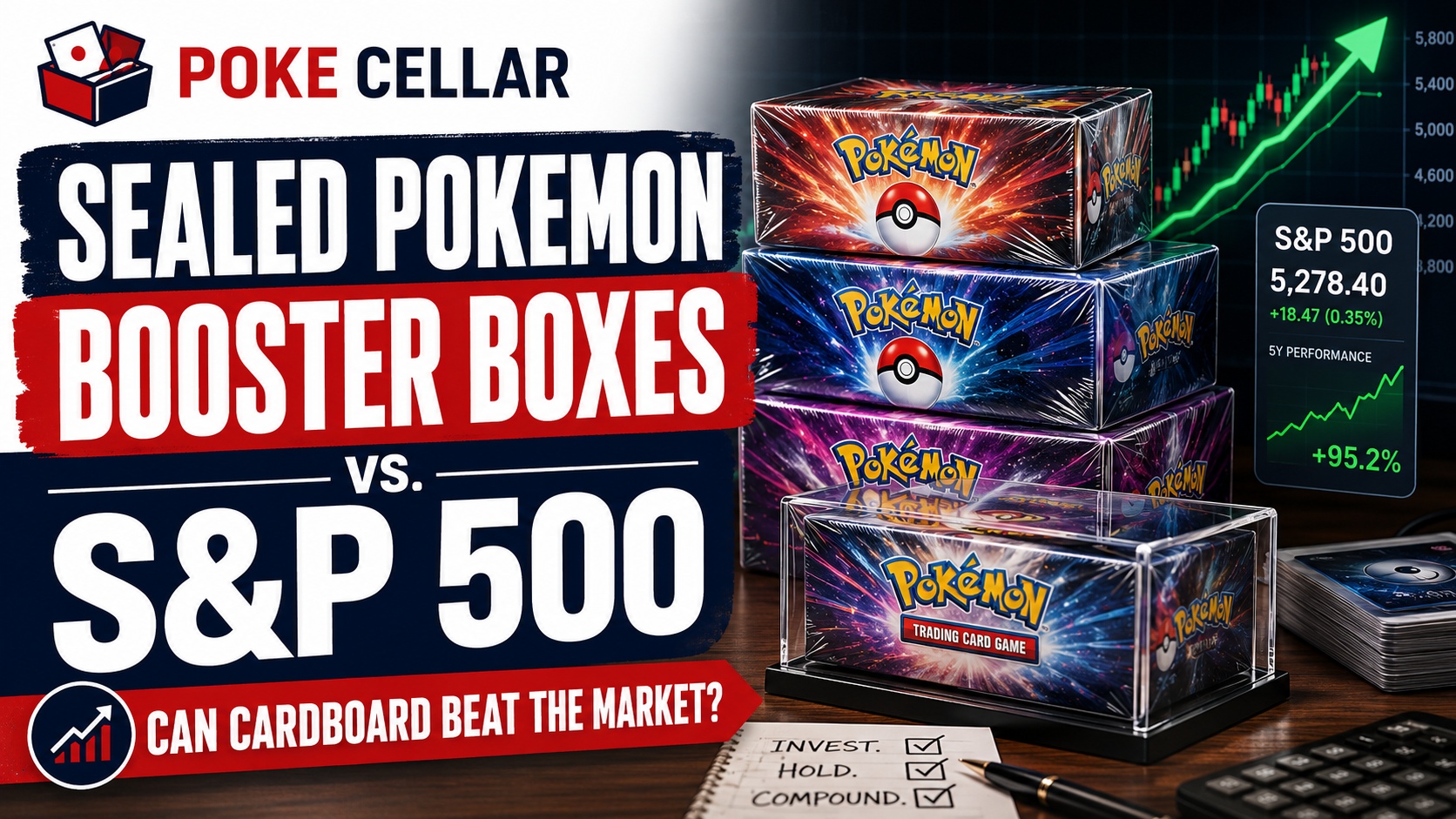
The argument is not that sealed Pokémon boxes are safer than the S&P 500. They are not. The argument is more specific: as a scarce collectible asset tied to one of the strongest entertainment franchises in the world, sealed Pokémon booster boxes have produced historical returns that, in many cases, rival or dramatically exceed traditional equity-market returns.
The thesis deserves a real look.
The Investment Thesis
A sealed booster box has four traits that make it unusually interesting as an investment asset.
First, it is a finite product. Once a Pokémon set is out of print, no more sealed boxes from that original print run are supposed to be created.
Second, sealed supply naturally declines. Boxes get opened by collectors, ripped by streamers, damaged in storage, broken down into individual packs, or simply lost over time.
Third, Pokémon has multi-generational demand. A child who opened packs in 1999 became an adult collector in 2020. A child opening Sword & Shield packs in 2021 may become a higher-income nostalgic buyer in 2035.
Fourth, sealed boxes are the purest form of “unrealized potential.” A single graded card is already known. A sealed box still contains the possibility of every chase card in the set. That optionality has value.
That combination — finite supply, shrinking float, durable nostalgia, and embedded lottery value — is the core reason sealed Pokémon behaves differently from ordinary toys.
The S&P 500 Benchmark
To compare sealed Pokémon boxes to the S&P 500, we need a reasonable baseline.
The S&P 500 is often treated as the default long-term investment benchmark because it represents roughly 500 major U.S. public companies and is considered one of the best gauges of large-cap U.S. equities. S&P Dow Jones Indices describes the index as covering about 80% of available U.S. equity market capitalization.
Historically, a reasonable expectation for the S&P 500 is around 10% nominal annual return over very long periods, assuming dividends are reinvested. That is the hurdle rate sealed Pokémon needs to beat or rival.
The question is not, “Did one lucky Pokémon box outperform stocks?”
The better question is:
Has sealed Pokémon, as a category, shown repeated examples of equity-like or better-than-equity returns over meaningful holding periods?
The answer appears to be yes — with major caveats.
Case Study 1: 1999 First Edition Base Set Booster Box
The most famous example is the original 1999 Pokémon Base Set.
Heritage Auctions sold a sealed 1999 Pokémon First Edition Base Set booster box for $408,000 in January 2021. Heritage stated that the same set had broken a world record only months earlier when another box sold for $360,000 in November 2020.
This is the nuclear example.
A sealed booster box in 1999 was not a six-figure asset. It was retail inventory. Even if we assume a rough retail box cost around 36 packs × $2.99–$3.99 per pack, the original consumer cost would have been somewhere around the low hundreds of dollars. A move from roughly $100–$150 to $408,000 is not “beat the S&P 500” performance. It is venture-capital performance hiding inside a children’s card game.
Now, to be fair, this example is extreme. First Edition Base Set is not representative of every Pokémon box. It is the Mickey Mantle rookie card of sealed Pokémon. You should not use it as the expected return for modern boxes.
But it proves something important: sealed Pokémon boxes can become institutional-grade collectibles when the right combination of age, scarcity, set importance, and cultural relevance is present.
That matters.
Case Study 2: Unlimited Base Set — A More Grounded Vintage Example
The First Edition Base Set box is so rare that it almost distorts the discussion. A more grounded comparison is the regular 1999 Base Set booster box.
A 1999 Pokémon Base Set booster box authenticated by PWCC sold through Fanatics Collect in April 2024 for $12,600 including buyer’s premium.
That is dramatically lower than First Edition Base Set, but still a powerful long-term return.
If a sealed box cost roughly $100–$150 around release and later sold for $12,600, that implies roughly an 80x to 126x nominal return before fees, taxes, storage, and inflation.
For comparison, $100 invested in the S&P 500 in the late 1990s also grew meaningfully, especially with dividends reinvested — but not by anything close to 80x over the same period. The S&P 500 had strong years, crashes, recoveries, and compounding, but sealed Base Set boxes benefited from something equities do not have: a shrinking collectible supply curve.
Stocks can split, issue shares, dilute, merge, and get reweighted. A sealed 1999 booster box can only become rarer.
Case Study 3: XY Evolutions
Vintage boxes are easy to dismiss as “you had to be there.” So the more relevant test is whether later, less ancient sets also produced stock-market-level returns.
XY Evolutions is one of the clearest examples.
Released in 2016, Evolutions was initially treated by many collectors as overprinted and easy to find. For years, it was not considered some ultra-premium sealed product. It was everywhere.
That changed.
PriceCharting currently shows the Pokémon Evolutions booster box around $2,262.65, with recent 2026 completed sales commonly in the roughly $1,850–$2,200+ range and some outlier sales above that.
A standard Pokémon booster display box historically carried an MSRP around $143.64 for 36 packs, as reflected by Pokémon Center listings for 36-pack booster display boxes.
So even using MSRP as the cost basis, Evolutions moving from about $144 to about $2,263 is a gain of roughly 1,470%, or about 15.7x.
From 2016 to 2026, that works out to roughly 31–32% annualized before transaction costs.
That is the kind of return profile that absolutely rivals the S&P 500. In fact, over that specific period, it crushes it.
And importantly, Evolutions was not an obscure 1999 lottery ticket. It was a modern-era set that many collectors had the opportunity to buy.
Case Study 4: Sun & Moon — Team Up
Team Up is another striking modern example.
Released in 2019, Team Up became one of the most desirable Sun & Moon-era sets because of its Tag Team cards and strong character appeal. PriceCharting currently lists the Team Up booster box at about $10,028.52.
Again, using a rough booster box MSRP of about $143.64, a move to about $10,000 represents roughly a 70x return.
From 2019 to 2026, that implies a return so high that the S&P 500 is not really the right comparison anymore. It is closer to early-stage speculative asset performance.
Of course, Team Up is a cherry-picked winner. Not every Sun & Moon booster box performed like that. But that is also the point: sealed Pokémon investing is not equivalent to buying the whole market. It is closer to buying collectible inventory where set selection matters enormously.
The best sets can massively outperform. Mediocre sets can sit flat for years.
Case Study 5: Evolving Skies
Evolving Skies may be the defining modern sealed-box example.
Released in 2021, the set became famous for alternate-art Eeveelutions, especially Umbreon VMAX. PriceCharting currently lists the Evolving Skies booster box at about $2,560.86.
That is extraordinary for a product released only a few years ago.
If purchased near MSRP around $143.64, a box at $2,560 represents about a 17.8x return. Even if purchased above MSRP at $200, $250, or $300, the return is still massive.
The single-pack market supports the same story. TCGplayer currently shows Evolving Skies booster packs with a market price around $44.30, compared with the original standard booster-pack MSRP of roughly $3.99.
That matters because it shows demand is not only theoretical. The sealed box price is supported by the price of the packs inside, the chase cards, and the collector premium attached to sealed displays.
Evolving Skies is the modern bull case in one product: beloved Pokémon, strong chase cards, huge collector demand, limited sealed availability, and a willingness among buyers to pay far above original retail.
Why Sealed Booster Boxes Can Outperform
The reason sealed booster boxes can rival the S&P 500 is not mysterious.
They benefit from a simple mechanical advantage: sealed supply declines while collector demand can rise.
Every year, some boxes are opened. Every year, some are damaged. Every year, more collectors decide they want a clean sealed copy for their shelf, investment case, store inventory, YouTube channel, or long-term collection.
Unlike individual cards, booster boxes also avoid some of the grading lottery. A raw card may be off-center, scratched, miscut, or damaged. A sealed box is easier to understand: is it authentic, sealed, clean, and desirable?
That makes the asset relatively legible.
There is also a “box premium.” The value of a sealed box is not always just the value of 36 loose packs. A sealed box is a display piece, a historical artifact, and a guarantee of untampered pack distribution. That premium tends to become more important as sets age.
The S&P 500 Is Still Better in Several Important Ways
The bullish case is real, but it is very easy to oversell.
The S&P 500 has advantages sealed Pokémon cannot match.
It is liquid. You can sell an index fund in seconds.
It is diversified. You own hundreds of companies, not a few cardboard boxes.
It pays dividends. Booster boxes produce no cash flow.
It has transparent pricing. Pokémon prices are fragmented across eBay, TCGplayer, auction houses, Facebook groups, card shops, and private sales.
It has low transaction costs. Selling a booster box can involve platform fees, payment fees, shipping, insurance, grading/authentication, auction premiums, and fraud risk.
It is easy to store. A brokerage account does not need humidity control, shelf space, tamper protection, or insurance.
These differences matter.
A $10,000 S&P 500 position and a $10,000 stack of sealed Pokémon boxes may have the same paper value, but they are not equally convenient assets.
The Pokémon position is more operationally intensive. You have to source clean boxes, avoid fakes, store them correctly, protect them from dents and tears, track market values, and eventually sell them into a market where buyers are cautious and condition-sensitive.
So no, sealed Pokémon is not a clean replacement for the S&P 500.
But as an alternative asset, the performance data is hard to ignore.
The Best Version of the Theory
The credible version of the sealed Pokémon investment thesis is not:
“Buy any Pokémon product and get rich.”
That is nonsense.
The credible version is:
Factory-sealed booster boxes from desirable Pokémon TCG sets have historically shown the ability to produce equity-like or better returns because they combine collectible demand with structurally declining supply.
The strongest candidates usually have several traits:
- major chase cards
- popular Pokémon
- strong artwork
- low or interrupted availability
- meaningful nostalgia
- sealed booster-box format
- broad collector consensus
- clean condition
- no obvious long-term reprint risk
- franchise relevance beyond competitive play
This is why boxes like Base Set, Team Up, Evolutions, and Evolving Skies became important. They were not just random sealed products. They became cultural containers for a specific era of Pokémon collecting.
A Simple Return Comparison
Here is the rough shape of the argument:
| Asset | Approximate starting value | Later observed value | Approximate multiple |
|---|---|---|---|
| S&P 500 long-term benchmark | $1 | Long-term compounding around 10%/yr | Excellent, liquid, diversified |
| 1999 First Edition Base Set box | Low hundreds | $408,000 auction sale | Extreme outlier |
| 1999 Base Set unlimited box | Low hundreds | $12,600 sale in 2024 | Very strong vintage return |
| XY Evolutions box | ~$143.64 MSRP | ~$2,262 market | ~15.7x |
| Team Up box | ~$143.64 MSRP | ~$10,028 market | ~70x |
| Evolving Skies box | ~$143.64 MSRP | ~$2,560 market | ~17.8x |
The data does not say every box beats the S&P 500.
It says the right sealed boxes have historically been capable of doing so by enormous margins.
That distinction is everything.
The Main Risks
There are serious risks.
Reprint risk
Modern Pokémon products can be reprinted. A box that looks scarce today can become less scarce if The Pokémon Company releases more supply.
Set-selection risk
Bad or mediocre sets may underperform for years. Some boxes remain near retail or below retail for long periods.
Liquidity risk
There is no guaranteed instant buyer at the quoted market price.
Condition risk
A crushed, torn, sun-faded, or suspicious box may sell at a major discount.
Authenticity risk
Fake boxes, resealed boxes, and tampered products are real issues, especially in high-value vintage markets.
Fee drag
A stock index fund may cost a few basis points per year. Selling a booster box through a marketplace can easily cost 10% or more after platform fees, payment fees, shipping, insurance, and discounts.
No income
A booster box does not pay dividends. The entire return depends on someone else paying more later.
Cultural-cycle risk
Pokémon is one of the strongest franchises in the world, but collector enthusiasm can still move in cycles. Hype periods and downturns are both real.
So, Can Sealed Pokémon Booster Boxes Rival the S&P 500?
Yes — but not in the same way.
The S&P 500 is the better default investment. It is cleaner, easier, more liquid, more diversified, and more predictable.
Sealed Pokémon booster boxes are not that.
They are closer to a physical alternative asset: part collectible, part inventory, part nostalgia derivative, part scarce commodity.
But the historical evidence shows that the right sealed boxes can rival or exceed S&P 500 returns by a wide margin. Base Set, Evolutions, Team Up, and Evolving Skies are not abstract examples. They are real market data points showing that sealed Pokémon can transform from ordinary retail product into high-performing collectible assets.
The investment case is strongest when sealed boxes are treated with discipline:
Buy desirable sets.
Buy clean boxes.
Avoid overpaying during hype spikes.
Store them properly.
Think in years, not months.
Assume selling will take effort.
Do not confuse every sealed product with an investment-grade asset.
The S&P 500 compounds because businesses earn money.
Sealed Pokémon boxes compound for a different reason: the world slowly runs out of them.
That is the entire theory.
And historically, when demand survives long enough for scarcity to matter, that theory has worked shockingly well.